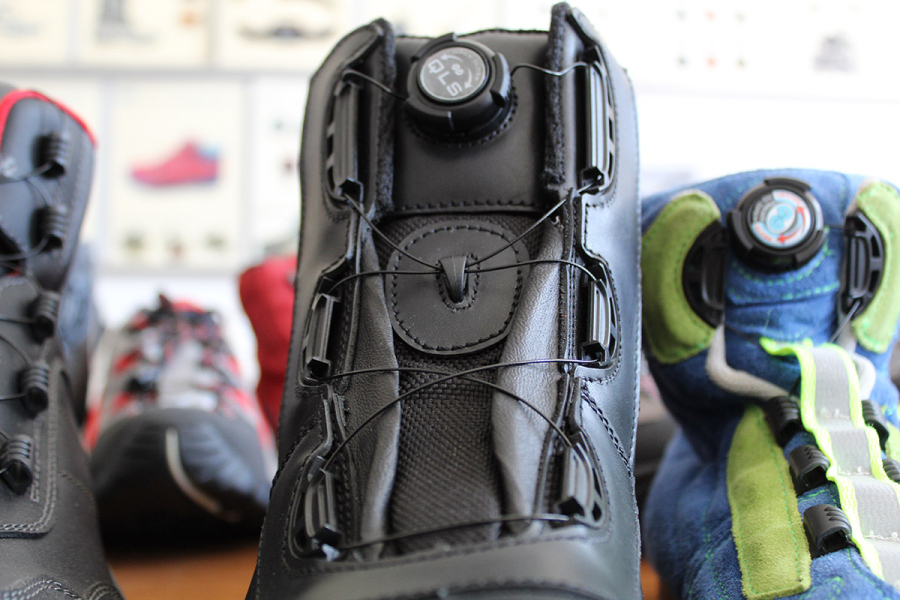
What are speed lacing systems?
Speed lacing systems include a series of devices designed to facilitate the fastening of shoes without resorting to traditional knots. They may include rotors, lace locks, advanced eyelets, or progressive tightening systems.
The goal is simple: improve the user experience, reduce lacing times, and ensure a more precise fit.
The main types
- Rotor systems for millimetric adjustment
- Quick-tightening lace locks
- Locking eyelets
- Hybrid systems with technical laces
Advantages over traditional laces
Quick-lacing systems offer several concrete advantages, both for the manufacturer and the end user.
From a functional point of view, they allow for a more uniform and controlled closure, improving the comfort and stability of the shoe during use.
Why are they used? chosen
- faster use
- precise and uniform adjustment
- reduced risk of unlacing
- improved ergonomics in movement
- cleaner and more technical design
Where they are most popular today
Despite their potential, speed-lacing systems are now mainly used in certain specific sectors, where technical performance is a determining factor.
Main areas of use
- sports footwear (running, trail, cycling)
- trekking and outdoor shoes
- safety footwear (safety)
- professional technical shoes
In these contexts, the need for speed, precision, and reliability makes speed-lacing systems a popular choice almost natural.
Why diffusion is still limited
Despite the numerous advantages, these systems have not yet achieved widespread diffusion in the footwear market, especially in the more traditional segments.
The reasons are various and involve both production and cultural aspects.
The main factors limiting their diffusion
The factors limiting their diffusion are essentially a consolidated habit of using traditional laces. Also of relevance are the costs of integration into production systems, which, in addition to the closure device, could influence the redesign of the upper. Returning to the cultural aspect, the quick-lacing system is still perceived as a more complex element when, data in hand, the opposite is true. Finally, design, which isn't always well-received or doesn't appear compatible with classic footwear styles, is a key consideration.
Especially in the fashion and lifestyle world, traditional laces still retain strong aesthetic and cultural value, which slows the adoption of alternative solutions.
An Evolving Market
Despite these limitations, the market is evolving rapidly. The growing focus on comfort, practicality, and performance is pushing more and more brands to experiment with innovative solutions.
Even in the fashion segment, we're starting to see hybrid applications, where speed-lacing systems are integrated while maintaining an aesthetic consistent with the product design.
The Future of Lacing Systems
Speed-lacing systems are likely to become increasingly widespread in the coming years, thanks to the evolution of materials, simplified mechanisms, and greater market acceptance.
Companies investing in research and development in this area are helping to redefine the very concept of shoe fastening, introducing more ergonomic, reliable, and high-performance solutions.
In this scenario, innovation is not just about technology, but also about the user experience, which is increasingly central to consumer choices.